About Pinnacle Performance
Our story

About Pinnacle Performance

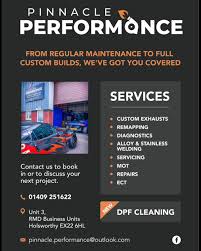
Jack Emery started Pinnacle Performance in Holsworthy in 2018, and seven years on the workshop at Unit 3, RMD Business Park has grown into the kind of garage most areas do not have: one that can service a family car in the morning and fabricate a custom exhaust or rebuild an engine in the afternoon, without sending work elsewhere.

Servicing, diagnostics, repairs, engine replacements, custom fabrication and ECU mapping are all carried out in-house by the same team, which means fewer delays waiting on outside specialists and one point of contact for the whole job, whatever it involves.

What began as local car servicing and repairs has grown to include a steady stream of HGV and agricultural customers, largely because Pinnacle Performance is one of the few workshops in the area equipped to handle diagnostics, ECU tuning, remapping and DPF cleaning on commercial and farm vehicles as well as cars. The workshop covers roughly a 50-mile radius of Holsworthy, with mobile tuning and remapping available further afield across Devon and Cornwall.

METClean DPF SpecialistGenuine Diagnostics and Tuning Tools
Get in touch

Find us, or have us come to you.

Visit
Unit 3
R M D Business Units, Holsworthy industrial estate, Holsworthy
EX22 6HL
Opening hours
Monday0830-1730
Tuesday0830-1730
Wednesday0830-1730
Thursday0830-1730
Friday0830-1730
SaturdayClosed
SundayClosed
Come to us

Areas we serve.

HolsworthyBudeLauncestonBidefordGreat TorringtonOkehamptonHatherleighBradworthyBarnstapleTavistockCamelford
We come to you

Mobile service.

Devon & Cornwall

Good to know

Frequently asked questions.

Mobile ECU tuning and remapping is available across Devon and Cornwall for customers and vehicles that cannot easily come to the workshop, using the same genuine tools and Mobile Eco Tuning accredited process used on site. Servicing, repairs, fabrication and DPF cleaning are workshop-based services carried out at Unit 3, RMD Business Park in Holsworthy.

Pinnacle Performance is open Monday to Friday from 8:30am to 5:30pm and closed on Saturdays and Sundays. The workshop is at Unit 3, RMD Business Park, Holsworthy.

The easiest way to book is online at https://pinnacle-performance.uk/booking, where you can choose your service, pick a date and time, and leave a deposit to secure the slot. Customers who prefer not to book online are welcome to call 01409 251622 or visit the workshop directly.

A manufacturer cannot automatically void your entire warranty just because your car has been remapped, but they can refuse warranty claims on components they can show were directly affected by the tune. Any modification, including a remap, should also be declared to your insurer, since undeclared modifications can invalidate a claim even on an unrelated incident.

METClean is a specialist DPF cleaning process that clears carbon and ash build-up from a blocked or failing filter, using on-vehicle chemical flushing for lighter blockages and off-vehicle machine cleaning for more stubborn cases. Pinnacle Performance is a METClean DPF specialist and has used the process to resolve DPF-related faults without the cost of a full filter replacement.

Pinnacle Performance carries out diagnostics, ECU tuning, remapping and DPF cleaning on HGVs and agricultural machinery as well as cars, which is uncommon for a workshop of this size in the area. This side of the business has grown as more fleet and farm customers have found there is nowhere closer able to deal with it properly.

Pinnacle Performance operates on a local, family-run trust model, so if you are not happy with work that has been carried out, the team will do all they reasonably can to resolve the issue. Getting in touch directly, by phone or in person at the workshop, is the quickest way to sort out any concern.

Yes, alongside routine servicing and repairs, Pinnacle Performance carries out engine replacements, full custom builds and bespoke stainless steel exhaust fabrication in-house. This is one of the main things that sets the workshop apart, since customers do not need to be sent elsewhere for the bigger jobs.

The most common signs of a blocked or failing Diesel Particulate Filter are a DPF warning light on the dashboard, reduced engine power or "limp mode", increased fuel consumption, a strong smell of diesel or exhaust fumes, and difficulty starting the car. If regeneration cycles are failing repeatedly, you may also notice the engine running rougher at idle and black or grey smoke from the exhaust under acceleration.

Whether your DPF needs cleaning or full replacement usually comes down to a proper diagnostic check rather than guesswork. A technician will use OBD diagnostics to check soot loading percentages, back pressure readings, and DPF differential pressure sensor data. If the filter substrate itself is cracked, melted or physically damaged, cleaning will not resolve it and replacement is the only safe option.

DPFs typically block up from a pattern of short journeys and low speed urban driving that never gets the exhaust hot enough to trigger a passive or active regeneration. Faulty EGR valves, worn injectors, poor quality fuel, and ignoring an active regeneration in progress (by turning the engine off) are also common causes of premature DPF blockage.

Off-vehicle cleaning involves physically removing the DPF from your car and cleaning it inside a sealed machine, rather than injecting chemicals through the pressure sensor port while it stays fitted. It is typically the next step when an on-vehicle chemical flush has not cleared a stubborn blockage, commonly heavy oil-ash contamination or back pressure that stays high after cleaning, at which point workshops using METClean cabinet equipment clean the filter using hydrodynamic micro-cavitation technology, physically breaking ash loose from deep within the substrate.

Your DPF is placed inside a sealed cabinet where it goes through a wash, chemical soak and rinse cycle using a technique called micro-cavitation, in which controlled water flow creates microscopic bubbles that collapse against the ash deposits and physically break them loose from the filter cells. The filter is then dried using heated air (up to around 93°C) and put through a final flow test.

In most cases, yes. An off-vehicle METClean clean can restore a DPF that has failed an MOT smoke or emissions test, provided the filter substrate itself is not physically cracked or melted. The wash, chemical and micro-cavitation cycle is specifically designed to strip out the ash and soot build-up that causes high smoke readings, often bringing a vehicle back within legal emissions limits and ready to pass its retest.

Petrol ECU remapping adjusts the parameters your engine control unit uses to manage fuel delivery, ignition timing, boost pressure (on turbocharged engines) and throttle response. On a modern turbo petrol engine, a well calibrated remap can unlock power and torque gains that the factory map deliberately holds back for market, emissions or component cost reasons.

Typical Stage 1 petrol remaps on turbocharged engines deliver gains of roughly 15 to 30 percent more power and torque, depending on the engine's factory tune, hardware and how conservatively the manufacturer set the original map. Naturally aspirated petrol engines see smaller gains, usually in the 5 to 10 percent range, since there is no boost pressure to safely increase.

When carried out professionally within the safe limits of your engine's factory hardware, pistons, turbo, fuelling and cooling, a Stage 1 petrol remap is generally considered safe for long term use. Problems tend to arise from poorly written generic maps or pushing power levels that exceed what the standard clutch, turbo or fuel system can reliably handle.

A properly calibrated diesel remap often improves fuel economy alongside power and torque gains, because diesel engines are tuned more conservatively from the factory for emissions and durability margins than for outright efficiency. Many diesel customers report smoother throttle response and reduced turbo lag as the most noticeable everyday benefit, not just the extra bhp figure.

Diesel engines respond particularly well to remapping because they are usually turbocharged and run conservative factory boost and fuelling limits, so typical torque gains range from 20 to 40 percent depending on the vehicle and stage of tune. This torque increase is often felt more than the power increase, especially in mid-range overtaking and towing situations.

A well written diesel remap should not cause DPF or EGR problems on its own, but a poor quality or overly aggressive map can increase soot production and speed up DPF blockage. This is why remaps should always be carried out by a technician who understands the condition of your exhaust system, and why some workshops offer combined tuning and DPF maintenance packages.

Removing or deleting a Diesel Particulate Filter from a vehicle that was fitted with one from the factory is illegal for use on UK public roads, and it is also an automatic MOT failure under current emissions testing rules. Vehicles found with a DPF removed can face fines, points, and, because it invalidates insurance in most cases, no cover at all if the car is involved in an accident.

An emissions component delete means physically or electronically removing parts such as the DPF, EGR valve, catalytic converter or lambda sensors that were fitted to meet your vehicle's original emissions certification. Deleting any of these components for road use is illegal in the UK, since it takes the vehicle outside the emissions standard it was type approved and MOT tested against.

The safest route is a Stage 1 style remap that leaves all factory emissions equipment (DPF, EGR, catalytic converter) fully intact and simply optimises the fuelling, timing and boost maps within your engine's original hardware limits. This approach delivers real, usable power and torque gains while keeping your car fully MOT legal, road legal and insurable.

A "pops and bangs" map, which adjusts ignition and fuelling on the overrun to create exhaust crackle, sits in a legal grey area rather than being straightforwardly illegal. The map itself is not banned, but it can fall foul of noise limits, MOT emissions rules and anti-social behaviour or nuisance regulations depending on how it is set up and used. Many tuners offer it strictly for private land or track use rather than public roads to avoid these issues.

HGV remapping replaces the manufacturer's default ECU calibration with a customised one that fine-tunes fuel delivery and engine management for your specific truck and duty cycle. This can lift horsepower and torque, sharpen throttle response, and give you more usable low-down torque for pulling away with a load, while also improving fuel economy over a typical duty cycle.

Yes, HGV remapping is available across all the major manufacturers, including Mercedes, DAF, Volvo, Scania, Renault and Iveco, whatever your fleet mix. The remap is tailored to the specific engine and ECU fitted to your vehicle rather than being a generic file, so gains and driveability improvements are consistent across brands.

The principle is the same, adjusting fuel delivery and combustion parameters in the ECU, but agricultural and plant remaps are calibrated for the very different duty cycle of tractors, combine harvesters, excavators and bulldozers, which spend long periods under sustained heavy load rather than variable road driving. Remapping this equipment typically delivers more power, increased torque and better fuel economy while keeping performance reliable under continuous field or site work.

Remapping is available across the major agricultural and construction brands, including John Deere, Massey Ferguson and New Holland, alongside most other tractor, harvester and plant equipment manufacturers. As with HGV tuning, the map is built around the specific engine and ECU fitted to your machine rather than a one size fits all file.

No, commercial vehicle and agricultural remapping is typically carried out on-site using a fully mobile service, with a technician plugging in at your depot, yard or farm rather than requiring you to bring the vehicle in. This is particularly useful for fleets and farms where taking a truck or tractor off the road for a workshop visit means lost time and money.

Where both are fitted, it is generally recommended to remap the transmission control unit (TCU) alongside the ECU, since the two units constantly exchange real-time data about what the vehicle is doing. Remapping both together keeps engine and gearbox behaviour properly coordinated, whereas remapping only the ECU can leave shift points and torque management out of step with the new power delivery.

Yes, if your DPF has already been taken off the vehicle, whether by you or another workshop, it can be sent away for inspection, cleaning and return rather than needing to book the whole vehicle in. This is a common route for HGV and agricultural filters, where the size and weight of the DPF often makes it more practical to remove and courier than to bring the entire vehicle to a specialist.

Yes, refurbishment is significantly cheaper than a full replacement DPF, and the saving is particularly noticeable on HGV, agricultural and plant equipment, where replacement filters carry a much higher price tag than car sized units. Refurbishment also avoids the environmental cost of manufacturing a new filter, which is an added benefit for fleet and farm operators managing sustainability commitments alongside running costs.